
From outsourcing to local production : how KALEBASSE is growing its printing business in Mali
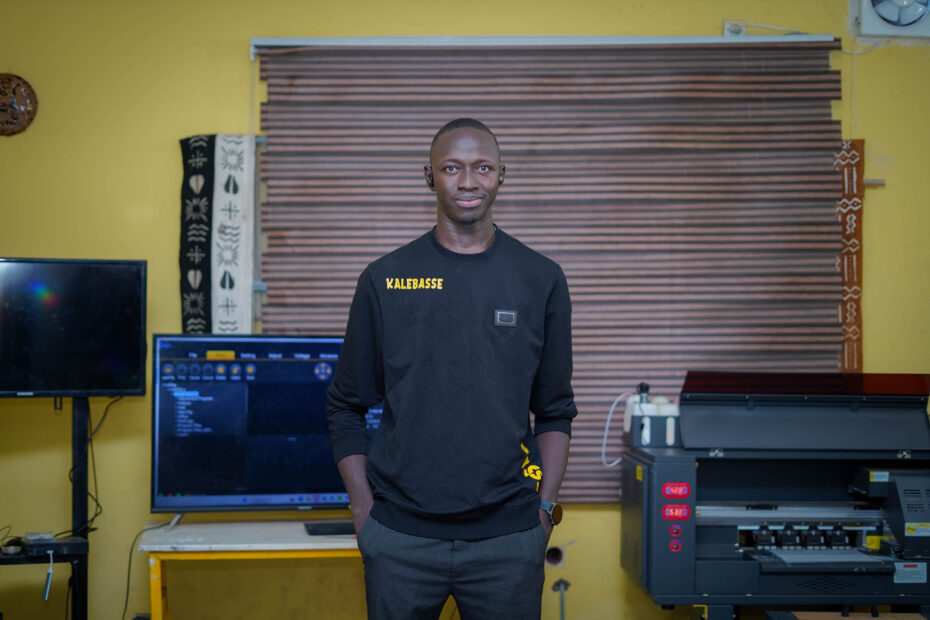
Standing between design screens and large-format printing equipment in his Bamako workshop, Aboubacar Kanouté can now follow more of a customer’s order from idea to finished product. For his company, KALEBASSE, that change means more than acquiring machinery. It means greater control over quality, delivery time and the value created by each job.
Founded in 2019, KALEBASSE specialises in digital printing, customised products and graphic design training. The company prints and personalises T-shirts, mugs, caps, banners and other communication materials. It also teaches young people and entrepreneurs how to use tools such as Photoshop, Illustrator, InDesign, Canva and artificial intelligence for visual communication.
Before receiving support through FACEJ II, KALEBASSE had to outsource part of its printing work. This raised production costs, delayed deliveries and made it harder to organise work around customer needs. An investment of FCFA 6,283,000 – approximately DKK 71,000 – was mobilised through FACEJ II in March 2026. It enabled the company to strengthen its production capacity with a 1.8-metre plotter and a multifunction copier, combined with training, coaching, management support and business networking.
The new equipment has allowed KALEBASSE to bring more work in-house. The company can plan production more efficiently, reduce its dependence on other printers and retain more of the revenue generated by each order. Additional income has already been reinvested in further equipment, extending the effect of the initial investment.
The financial results point to a business gaining momentum. KALEBASSE recorded annual turnover of FCFA 14,320,990 in 2025. From January to June 2026, turnover reached FCFA 10,873,927 – 75.9 per cent of the total for the entire previous year. In June 2026 alone, monthly turnover was FCFA 2,304,977, almost twice the average month in 2025.
KALEBASSE maintains six permanent jobs, four held by men and two by women. Its contribution extends beyond its own workforce. Through internships, online content and practical courses, the company reports that it has trained thousands of young people in graphic design and digital creation. Some content is available in Bambara, helping make technical skills accessible to a wider audience.
Innovation is also becoming part of the production process. KALEBASSE uses artificial intelligence to help customers visualise and adjust designs before printing. This can reduce errors, save time and make the interaction between designer and customer more efficient. The company’s growing technical expertise has also led to new commercial opportunities, including representing the YINGHE printing equipment brand in Mali and supporting the installation of machines for other buyers.
| “The support helped us strengthen our equipment, expand our training activities and grow the company. Through KALEBASSE, we have been able to train thousands of young people and contribute to their professional integration.”
Aboubacar Kanouté, founder of KALEBASSE |
Aboubacar’s ambitions now include a CNC machine, a 3D printer, two additional young employees with gender balance in mind, a regional branch and a shop for printing supplies. Each step is intended to deepen local production and open new pathways into creative and technical work.
KALEBASSE’s story shows how a targeted investment, combined with practical business support, can remove a specific bottleneck and give a young enterprise room to grow. FACEJ II is financed by the Kingdom of Denmark, with co-financing from the Kingdom of the Netherlands. It is implemented under the aegis of Mali’s Ministry of National Entrepreneurship, Employment and Vocational Training, with the PROMAN-ACK International consortium serving as fund manager.